
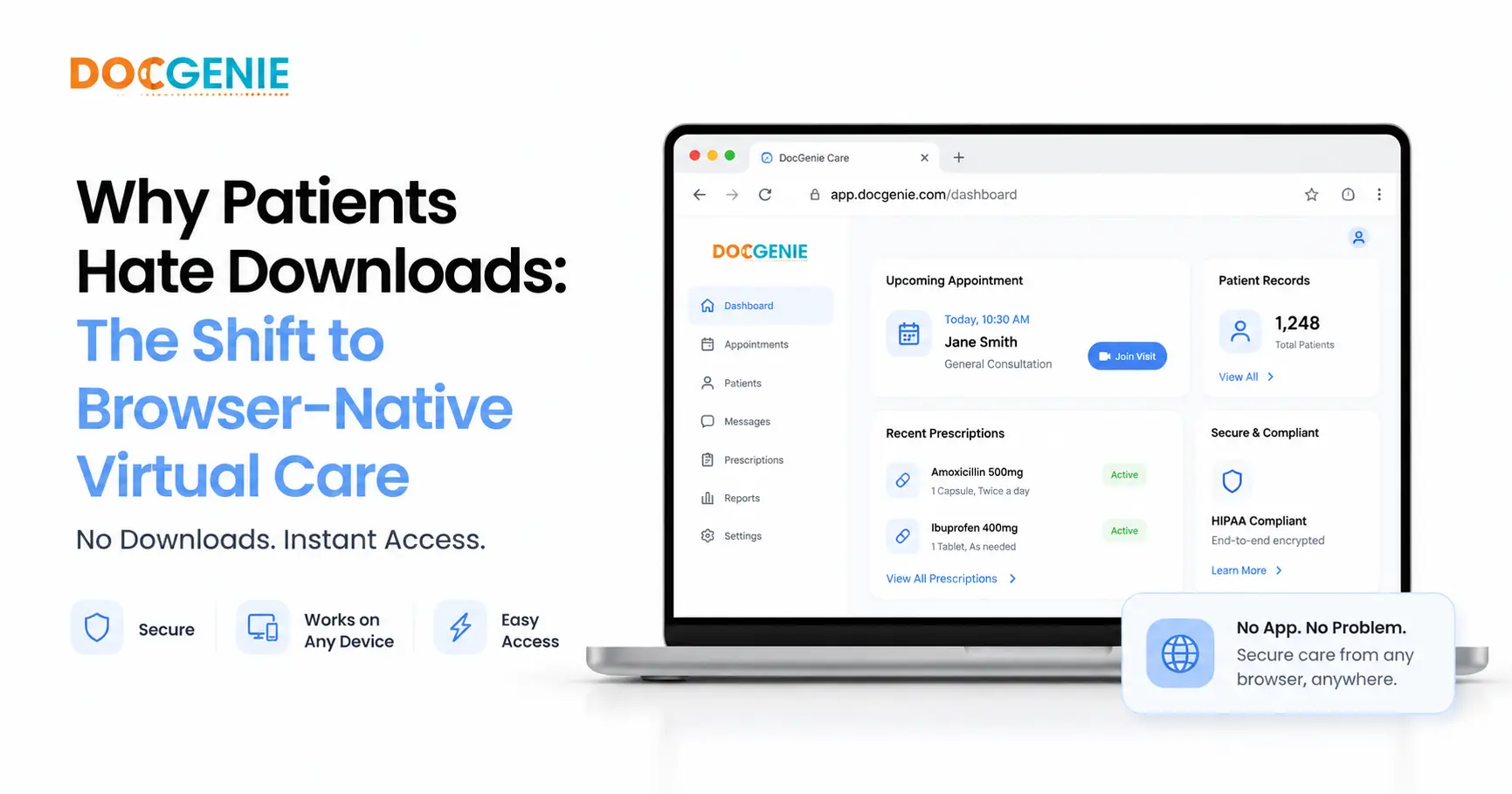
Browser-Native Virtual Care: Why Patients Hate Downloads
Table of Contents
Introduction
Learn why patients prefer browser-native virtual care over app downloads and how no-download access can improve patient experience, workflows, and care continuity.
Why Your Patients Hate Downloads: The Shift to Browser-Native Virtual Care
Patients do not want another app on their phone.
They do not want to search for it, download it, create another login, remember another password, update it every few weeks, or troubleshoot why it is not working on their device.
This becomes even more frustrating when they are already unwell, anxious, elderly, caring for a family member, or trying to get medical help quickly.
For healthcare providers, this is an important signal.
A virtual care platform is only useful if patients can access it easily. If the first step in the care journey is an app download, many patients may drop off before the consultation even begins.
This is why browser-native virtual care is becoming an important part of digital healthcare delivery. Instead of forcing patients into app-based ecosystems, browser-based virtual care platforms allow patients and doctors to access secure healthcare workflows directly through a web browser.
The result is a more accessible, flexible, and connected healthcare experience for everyone involved.
What Is Browser-Native Virtual Care?
Browser-native virtual care refers to healthcare platforms that operate directly through a web browser instead of requiring patients to download and maintain a dedicated mobile app.
Patients can access care through a secure web link, custom domain, patient portal, or browser-based login page. Depending on the platform, access may be supported through OTP verification, secure credentials, biometric authentication, or other approved identity checks.
For doctors and clinic teams, browser-native virtual care can also provide web-based access to appointment calendars, patient dashboards, EMRs, e-prescriptions, payments, secure messaging, reporting, and admin workflows.
The purpose is not simply to avoid apps. The purpose is to make digital care easier to access, easier to integrate, and easier to scale.
A browser-native virtual care platform can support:
In other words, browser-native care can deliver the depth of a digital clinic without forcing every patient into an app-first experience.
The Problem with Downloads in Digital Healthcare
Healthcare apps were once seen as the obvious answer to virtual care.
If patients wanted online consultations, digital prescriptions, appointment reminders, and access to records, the thinking was simple: build an app and ask them to download it.
But in practice, downloads create friction.
For many patients, downloading an app is not a small step. It can become a barrier to care.
Not Every Patient Has the Right Smartphone
App-based healthcare assumes that every patient has a smartphone that is compatible, updated, functional, and capable of running the latest version of the platform.
That assumption is not always true.
Many patients use older devices. Some do not update their operating systems regularly. Others may not have enough storage space. Some share devices with family members. Elderly patients may rely on caregivers for app installation, password management, software updates, or troubleshooting.
This creates unnecessary friction for a service that should be designed around access.
A patient should not miss a follow-up consultation because their phone does not support the latest app version. They should not have to postpone care because they forgot an app password or cannot complete an update.
Healthcare access should not depend on whether a patient is comfortable managing apps.
App-Based Care Requires Too Much Digital Effort
A large part of the patient population is not digitally native.
Some patients are comfortable using advanced digital tools. Others are not. Elderly patients, patients with disabilities, patients in rural areas, and patients with limited digital literacy may find app-based care difficult to navigate.
This matters because healthcare providers cannot design virtual care only for the most digitally confident patients.
If a digital clinic works well only for patients who are comfortable with app downloads, permissions, updates, passwords, file uploads, and in-app navigation, it risks excluding the people who may need accessible health
Virtual care should reduce barriers, not create new ones.
A browser-native virtual care platform can make the entry point simpler. Patients can receive a secure link, verify their identity, and access the consultation or patient portal through a browser. This removes several steps that often cause confusion in app-based workflows.
Heavy Apps Can Struggle in Low-Bandwidth Environments
Digital healthcare often involves more than a quick video call.
Patients may need to upload lab reports, previous prescriptions, discharge summaries, medical history documents, insurance records, images, or ongoing vitals data. Doctors may need to review those records, update EMRs, issue prescriptions, share instructions, and conduct video consultations.
For app-based platforms, this can become difficult in lower-bandwidth environments. Heavy downloads, app updates, large file uploads, and video consultations can all place strain on patients with unstable connectivity.
This is especially important in regions where internet access is inconsistent or expensive. It is also relevant for patients using older devices or limited data plans.
Browser-based healthcare platforms can reduce some of this friction when designed with adaptive video quality, compressed uploads, progressive loading, and lightweight access.
While video consultations still require stable connectivity, browser-native care can avoid the additional burden of app downloads and repeated updates.
For patients, that can make the difference between accessing care and dropping off.
Apps Can Create Siloed Healthcare Experiences
The biggest problem with app-based care is not just downloads. It is fragmentation.
Patients often use multiple apps for different health needs. One app may track vitals. Another may be used for doctor consultations. A third may manage chronic condition progress. Another may store lab reports. A pharmacy app may manage medication orders. An insurance app may handle claims.
Each app may work well on its own, but together they create a disconnected experience.
Patients are left trying to move information between systems. They may need to download a report from one app, upload it to another, screenshot a prescription, forward a file over chat, or explain their medical history repeatedly.
For doctors, the experience can be equally frustrating. They may not have a complete view of the patient’s health information in one secure place. They may need to ask the patient to resend files, search through messages, review scattered documents, or make clinical decisions with incomplete context.
This makes continuity of care harder.
If a doctor cannot see previous consultations, current prescriptions, past reports, vitals trends, follow-up notes, and referral history in one connected workflow, the quality of care can suffer.
Virtual care should not feel like digital paperwork. It should feel like one connected care experience.
Why Patients Prefer Browser-Based Virtual Care
Patients prefer healthcare experiences that are simple, familiar, and low-friction.
Most patients already know how to open a link. They may not know how to download a new healthcare app, grant permissions, update software, troubleshoot login issues, or navigate a complex interface.
Browser-based care reduces the number of steps between the patient and the provider.
This is especially useful for:
A browser-native platform also makes virtual care more flexible.
Patients can access care from a smartphone, tablet, laptop, desktop computer, or shared family device. They are not locked into a specific app ecosystem, operating system, or device model.
This flexibility matters because healthcare access should be device-neutral wherever possible.
If a patient has an internet connection and a browser, they should be able to begin their care journey.
Why Doctors Benefit from Browser-Native Care
Browser-native care is not only better for patients. It can also be better for doctors.
Doctors need speed, context, and reliability. They need to see patient history, review uploaded records, conduct consultations, issue prescriptions, document care, and manage follow-ups without switching between disconnected systems.
A browser-based virtual care platform can bring these workflows into one place.
Instead of juggling multiple apps, doctors can log into a secure web dashboard and access the information they need. This can include previous consultations, current prescriptions, medical records, vitals, lab reports, appointment history, referral notes, and follow-up plans.
When doctors have a more complete view of the patient journey, they can deliver more informed care.
This is especially valuable for chronic care management, post-operative reviews, elderly care, mental health follow-ups, specialist consultations, preventive care, and long-term treatment plans.
Browser-native care can also make it easier for doctors to work across approved care settings. A provider may consult from a clinic, hospital, home office, or another secure environment while still using the same centralized system.
The value is not just convenience. It is clinical continuity.
Browser-Native Care Supports Better Workflow Integration
Many hospitals, clinics, and healthcare providers already have legacy systems that support daily operations. These may include EMRs, EHRs, scheduling systems, payment tools, lab systems, pharmacy partners, insurance workflows, and internal reporting processes.
One concern healthcare leaders often have is whether a virtual care platform will replace or disrupt these existing workflows.
A strong browser-based virtual care platform should do the opposite. It should integrate with critical workflows rather than displacing them.
Because browser-native platforms are not confined to closed app ecosystems, they can often support more flexible integrations with existing systems. This helps clinics centralize workflows without forcing doctors, admin teams, or patients to move between unrelated tools.
For example, a browser-based virtual care setup can help connect:
This kind of centralization is essential for healthcare providers that want to scale virtual care without adding operational complexity.
The goal is not to create another digital silo. The goal is to build a connected care environment.
Browser-Native Care Can Improve Continuity of Care
Continuity of care depends on the ability to track the patient journey over time.
A single video consultation is not enough. Doctors need access to the patient’s medical history, previous prescriptions, lab reports, vitals, follow-up notes, and referral history. Patients need a secure place to access records, appointments, prescriptions, and reminders.
Browser-native care supports this by making the platform easier to access and easier to centralize.
When patients can log in from any device and doctors can access the right information from one secure dashboard, virtual care becomes more consistent.
This helps providers:
For patients, this creates a more reliable experience. They do not need to remember which app contains which file or which platform was used for the last consultation. They can access their care journey from one trusted digital destination.
For doctors, it means better context and fewer gaps.
For clinics, it creates a stronger foundation for high-quality virtual care.
App-Based Care Still Has a Place, But It Should Not Be the Only Doorway
This does not mean healthcare apps are useless.
Some patients like apps. Apps can be useful for high-frequency engagement, push notifications, remote monitoring, device integrations, wellness tracking, and ongoing care programs.
But apps should not be the only way to access virtual care.
A patient who does not want to download an app should still be able to consult a doctor, access prescriptions, upload records, and attend follow-ups. A clinic should not lose patients simply because the digital entry point is too demanding.
The best virtual care platforms are flexible.
They support browser-based access while also offering app-based experiences where appropriate. This gives healthcare providers more reach and gives patients more choice.
What Healthcare Leaders Should Look for in a Browser-Native Virtual Care Platform
When evaluating browser-based virtual care software, healthcare leaders should look for more than a video consultation link.
A strong platform should support secure, end-to-end healthcare workflows.
Key capabilities include:
The platform should also be easy to use.
Browser-native care only works if the interface is simple, intuitive, and reliable for both patients and providers.
A healthcare platform should not make users feel like they are navigating a complex technology product. It should help them get care, deliver care, and manage care with less friction.
How DocGenie Global Supports Browser-Native Virtual Care
DocGenie Global helps healthcare providers, vendors, and ecosystem players launch branded virtual care platforms without building technology from scratch.
DocGenie Global’s white-label telemedicine platform supports secure virtual consultations, patient registration, doctor onboarding, appointment scheduling, EMR workflows, digital prescriptions, patient communication, payments, analytics, and integrations with third-party services.
For healthcare organizations that want to reduce app-related friction, DocGenie Global supports web-based branded access through custom domains and a customizable patient experience. This allows providers to deliver virtual care under their own brand while making access easier for patients across devices.
The platform is designed to help providers move beyond disconnected tools and app-first limitations. By centralizing key workflows, DocGenie Global helps clinics and healthcare organizations create a more connected virtual care experience for both patients and doctors.
Patients get easier access to care. Doctors get better clinical context. Admin teams get clearer workflows. Healthcare organizations get a scalable, branded digital clinic that supports continuity of care.
The future of virtual care is not about forcing every patient to download another app. It is about making care easier to access, easier to manage, and easier to trust. Browser-native care is a major step in that direction.
Final Thoughts
Healthcare access should not depend on whether a patient is willing or able to download another app.
For many patients, app downloads create unnecessary friction. They add steps, increase confusion, require storage space, depend on device compatibility, and can make care harder to access for elderly patients, low-bandwidth users, and people with limited digital confidence.
Browser-native virtual care removes much of this friction.
It allows patients to access care through a secure browser while giving doctors, administrators, and healthcare organizations the connected workflows they need to deliver safe and reliable virtual care.
For healthcare leaders, the shift is clear: the future of digital care should be flexible, accessible, secure, and device-neutral.
Frequently Asked Questions
What is browser-native virtual care?
Browser-native virtual care is a healthcare delivery model where patients and providers access virtual care services directly through a secure web browser instead of downloading a dedicated app.
Why do patients prefer browser-based virtual care?
Patients prefer browser-based virtual care because it reduces friction. They can access consultations, records, prescriptions, and follow-ups through a secure link or web portal without downloading an app, updating software, or managing another login.
Is browser-native virtual care secure?
Yes, browser-native virtual care can be secure when built with healthcare-grade safeguards such as secure authentication, encryption, role-based access controls, audit trails, protected patient dashboards, and compliance with applicable healthcare data regulations.
Can browser-native virtual care support EMRs and e-prescriptions?
Yes. A strong browser-native virtual care platform can support EMR and EHR workflows, e-prescriptions, patient record uploads, appointment scheduling, secure messaging, payments, and follow-up reminders through a web-based interface.
Does browser-native care replace healthcare apps?
Not necessarily. Apps can still be useful for high-frequency engagement, wellness tracking, push notifications, and remote monitoring. However, browser-native access gives patients a no-download option and should not be excluded from the virtual care strategy.
How does DocGenie Global support browser-native virtual care?
DocGenie Global provides a white-label telemedicine platform that supports branded browser-based access, secure virtual consultations, patient dashboards, doctor workflows, EMR support, e-prescriptions, payments, communication, analytics, and integrations.
Related Articles

How Virtual Care Platforms Can Help Clinics Reach More Patients and Grow Revenue

7 Benefits of Integrating a White-Label Telemedicine Solution for Clinics and Hospitals

Here's How You Can Effectively Train Your Clinic's Staff to Deliver High Quality Virtual Care
Build Browser-Native Virtual Care with DocGenie Global
Talk to DocGenie Global’s team to explore how your clinic, hospital, healthcare network, or digital health business can deliver no-download virtual care with confidence.