
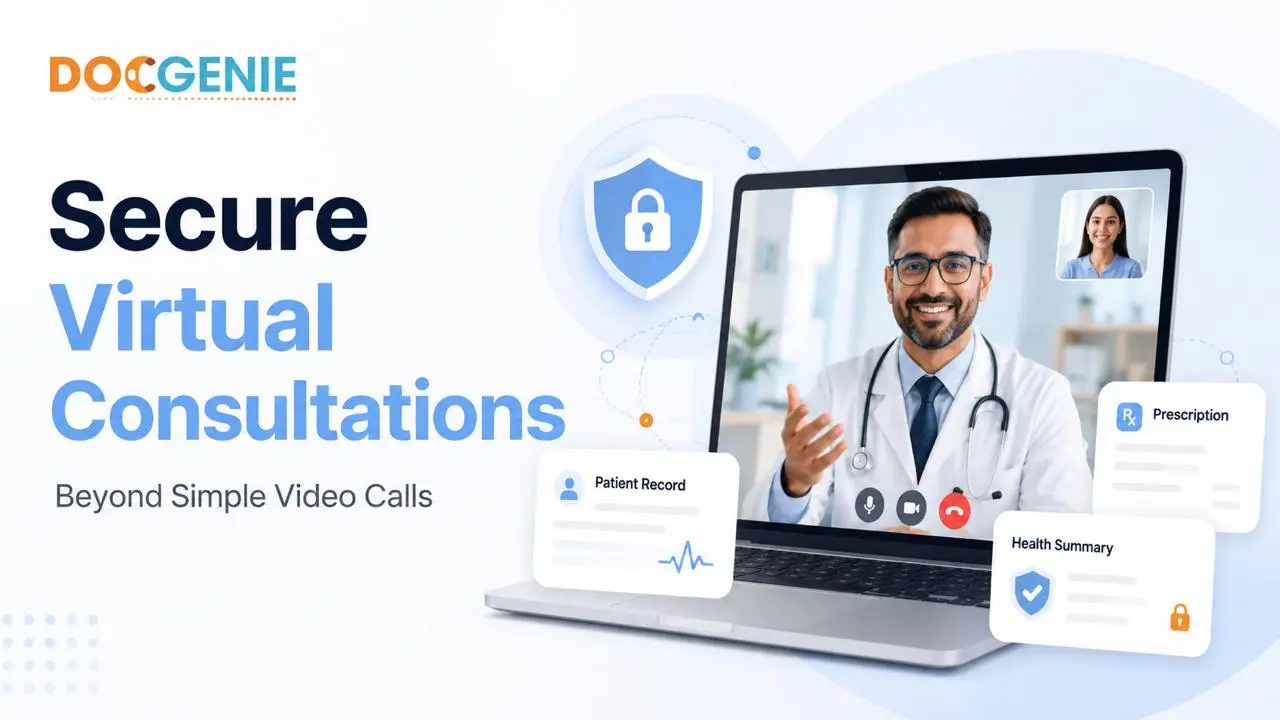
Secure Virtual Consultations Beyond Video Calls
Table of Contents
Introduction
A secure virtual consultation is not just a digital conversation. It is part of a complete healthcare workflow that includes patient registration, appointment scheduling, consultation notes, electronic medical records, prescriptions, follow-ups, referrals, payments, alerts, and secure communication.
The Anatomy of Secure Virtual Consultations: Why Healthcare Needs More Than Simple Video Calls
When most people think of a virtual consultation, they imagine a basic video call between a doctor and a patient. A patient joins from one screen, a doctor joins from another, the consultation happens, and a prescription is shared afterward.
That may sound convenient, but in healthcare, a video call alone is not enough.
A secure virtual consultation is not just a digital conversation. It is part of a complete healthcare workflow that includes patient registration, appointment scheduling, consultation notes, electronic medical records, prescriptions, follow-ups, referrals, payments, alerts, and secure communication.
For clinics, hospitals, and healthcare groups, the real value of virtual care is not in offering video appointments. The real value comes from building a secure, centralized, and compliant virtual care system that supports the entire patient journey.
This is where healthcare providers need to look beyond simple video tools and consumer messaging apps. A modern virtual care platform must be built for clinical workflows, patient data protection, operational efficiency, and long-term continuity of care.
What Is a Secure Virtual Consultation?
A secure virtual consultation is an online doctor-patient interaction that takes place within a protected, healthcare-ready digital environment.
Unlike a basic video call, a secure virtual consultation is connected to the patient’s complete care journey. The doctor can access relevant medical history, review previous consultations, document clinical notes, issue e-prescriptions, communicate follow-up instructions, and maintain a proper record of the interaction.
A secure virtual consultation setup should include:
This complete setup helps clinics deliver virtual care that is not only convenient, but also clinically reliable, operationally structured, and secure.
What a Robust Virtual Care Setup Should Include
A strong virtual care setup is designed around the complete patient journey, not just the appointment itself.
Here are the key components every clinic or healthcare organization should look for.
1. Secure Patient Registration and Onboarding
The patient journey begins before the consultation.
A secure virtual care platform should allow patients to register through a structured onboarding process. This includes capturing essential personal details, health information, consent, and any required documents in a secure format.
This information should directly connect to the patient’s profile so doctors and care teams can access accurate details before the consultation begins.
Good registration is not just an administrative step. It sets the foundation for safe, organized, and personalized care.
2. Dedicated Patient Dashboards
Patients should have access to a secure digital dashboard where they can manage their healthcare journey.
A patient dashboard can include:
This gives patients a single place to access their health information instead of searching across emails, messages, or paper records.
For doctors, it also improves consultation quality because the patient’s history is available in one centralized location.
3. Structured EMR Management
Electronic medical records are essential for quality virtual care.
Doctors should be able to document consultation details in a structured way, update patient records in real time, and review previous medical history when needed.
A strong EMR workflow helps ensure that clinical information is not lost between visits. It also supports better decision-making, especially for patients who require ongoing care, chronic disease management, or specialist follow-ups.
Without structured EMRs, virtual consultations can become isolated interactions with limited long-term value.
4. Integrated E-Prescriptions
Prescriptions should not be shared casually through emails or chat messages.
A secure virtual care platform should allow doctors to generate e-prescriptions directly within the system. These prescriptions should become part of the patient’s medical record and remain accessible for future reference.
Integrated e-prescriptions help reduce errors, improve documentation, and create a more professional experience for patients.
They also allow clinics to maintain a clear record of what was prescribed, when it was prescribed, and by whom.
5. In-Built Secure Video Consultations
The video consultation itself should happen inside the healthcare platform.
Using external or consumer-grade video tools can create problems around data security, access control, record management, and patient experience.
An in-built video consultation feature keeps the interaction within the same secure environment as the appointment, EMR, prescription, and follow-up workflow.
For patients, this creates a smoother experience. For providers, it creates better governance and operational control.
6. Systematic Patient Communication
Patient communication should not depend only on manual calls or informal messages.
A secure virtual care platform should support automated and structured communication such as:
These touchpoints improve patient engagement and reduce the chances of missed appointments, incomplete follow-ups, or communication gaps.
In virtual care, communication is not a support feature. It is part of care delivery.
Why Centralization Is Critical in Virtual Care
A clinic may have many digital tools and still struggle to deliver good virtual care if those tools do not work together.
Centralization means that all major workflows operate inside one connected platform. Patient registration, consultations, EMRs, prescriptions, payments, communication, referrals, and reports should all connect through a unified system.
This creates one clear view of the patient journey.
For doctors, centralization means they can see the full patient history before making clinical decisions.
For patients, it means they do not have to move between multiple tools or repeatedly share the same information.
For administrators, it means better visibility into appointments, payments, doctor activity, refunds, discounts, and operational performance.
For clinic leadership, it means stronger governance and accountability.
Complete Consultation History in One Place
A doctor should be able to open a patient profile and immediately see previous consultations, notes, prescriptions, lab reports, referrals, and follow-up instructions.
This is especially important for patients with chronic conditions, long-term treatment plans, or recurring consultations.
When clinical information is incomplete or scattered, doctors may have to rely on patient memory or manually collected records. This can slow down consultations and affect care quality.
A centralized platform helps ensure that every consultation adds to a complete and updated patient record.
Better Progress Tracking and Monitoring
Virtual care becomes more powerful when it supports ongoing monitoring.
For patients managing conditions such as diabetes, hypertension, respiratory concerns, weight management, or long-term medication plans, doctors need visibility into progress over time.
A centralized platform can support vitals tracking, follow-up reminders, patient updates, and structured review points.
This helps providers move from reactive care to proactive care.
Instead of waiting for the next appointment, care teams can monitor patterns, identify concerns early, and guide patients more consistently.
Secure Doctor-Patient Communication
Clinical communication should happen inside a secure platform.
When messages, reports, prescriptions, or care instructions are exchanged through informal tools, the clinic loses control over documentation, access, and data protection.
Secure in-platform communication helps ensure that patient interactions are protected, recorded, and accessible when needed.
It also gives patients one trusted channel for communicating with their care team.
Compliance Is Not Optional in Virtual Care
Healthcare data is sensitive and highly personal. That is why virtual care platforms must be designed with compliance and security at the core.
For clinics and healthcare organizations, compliance is not just a technical requirement. It is a trust requirement.
Patients need to know that their health information is protected. Doctors need confidence that clinical records are secure. Clinic leadership needs assurance that the platform meets applicable regulatory and operational standards.
A secure virtual care platform should include:
- Independent security certifications
Role-Based Access Control
Not everyone in a clinic should have access to the same information.
Doctors, specialists, administrators, finance teams, and patients all require different access levels.
Role-based access control ensures that users can only view or manage the information relevant to their role. This helps protect patient privacy and reduces internal data exposure risk.
For example, a doctor may need access to patient records and clinical notes, while an admin user may only need access to appointment schedules and payment status.
This access should be controlled, logged, and revocable.
Alignment with Local Healthcare Data Regulations
Virtual care platforms must align with the regulations of the markets they serve.
Depending on where a healthcare organization operates, it may need to consider frameworks such as HIPAA, GDPR, India’s DPDP Act, Singapore’s PDPA, or other local healthcare data protection laws.
Some regions may also require data localization, consent tracking, auditability, or specific controls around how patient information is stored and transferred.
Healthcare providers should choose platforms that can support these requirements instead of relying on generic communication tools.
Why Consumer Messaging Apps Are Not Enough for Clinical Care
Consumer messaging apps may be convenient, but they are not built to manage clinical workflows.
They do not provide the same level of healthcare-specific access control, audit trails, structured documentation, patient record management, or administrative governance that clinics need.
Using informal tools for consultations, prescriptions, reports, or patient records can create serious risks around privacy, continuity of care, and compliance.
For professional virtual care, healthcare providers should use purpose-built platforms designed for secure clinical communication and documentation.
Internal Referrals Should Be Seamless
Virtual care is not limited to one doctor and one patient.
In many cases, a general physician may need to refer a patient to a specialist. A specialist may need access to previous notes, lab reports, prescriptions, and vitals. The admin team may need to coordinate scheduling and payment.
A well-designed virtual care platform makes this process smooth.
The referring doctor should be able to document the reason for referral inside the platform. The specialist should be able to access the relevant patient history without asking the patient to resend documents. The consultation should continue within the same care environment.
This improves efficiency and creates a better patient experience.
Operational Visibility for Admin and Finance Teams
A secure virtual care platform should also support the operational side of healthcare delivery.
Clinic managers and admin teams need visibility into daily operations. This may include:
Without this visibility, managing a virtual clinic becomes difficult.
A good platform should give leadership and admin teams clear reporting tools so they can make informed decisions.
Activity Trails for Governance and Accountability
Every important action inside a virtual care platform should be traceable.
This includes consultations completed, records accessed, prescriptions issued, payments processed, refunds initiated, messages sent, and documents uploaded.
Activity trails support governance, compliance, internal accountability, and operational transparency.
They also help clinic leadership understand how the platform is being used and where improvements may be needed.
What Healthcare Providers Should Look for in a Secure Virtual Care Platform
When evaluating a virtual care platform, clinics and hospitals should look beyond basic video consultation features.
The right platform should support clinical, operational, administrative, and compliance needs together.
Important features include:
A strong platform should reduce complexity, not add to it.
How DocGenie Global Supports Secure Virtual Care
DocGenie Global helps healthcare providers, clinics, hospitals, and ecosystem partners build secure, branded, and end-to-end virtual care platforms.
DocGenie Global is not just a video consultation tool. It is a white-label telemedicine platform designed to support the complete virtual care journey — from patient onboarding to consultation, EMRs, e-prescriptions, secure communication, payments, referrals, and operational management.
With DocGenie Global, healthcare organizations can create a virtual care setup that includes:
DocGenie Global is headquartered in Singapore and supports healthcare providers and ecosystem partners across 50+ countries. Its platform is HIPAA-compliant, SOC 2 Certified, and ISO/IEC 27001:2022 Certified, as stated in the provided company content.
For healthcare organizations looking to move beyond basic video calls, DocGenie Global provides the infrastructure to deliver virtual care that is secure, connected, scalable, and professionally managed.
Final Thoughts
Secure virtual consultations are not just about connecting a doctor and patient through video. They are about creating a complete digital care environment where every step of the patient journey is structured, protected, and connected.
Healthcare providers that rely only on basic video tools may be able to offer online appointments, but they often miss the bigger opportunity: better continuity of care, stronger patient engagement, improved operational control, and safer data management.
The future of virtual care belongs to clinics and healthcare organizations that build secure, centralized, and compliant systems — not disconnected digital shortcuts.
For providers ready to deliver virtual care beyond simple video calls, a purpose-built white-label telemedicine platform can provide the foundation for safer, smarter, and more scalable healthcare delivery.
Create a secure, branded, and fully integrated virtual care platform that goes beyond basic video consultations.
Talk to DocGenie Global’s team to explore how your clinic, hospital, or healthcare network can deliver connected virtual care with confidence.
Frequently Asked Questions
What is a secure virtual consultation?
A secure virtual consultation is an online doctor-patient consultation that takes place within a protected healthcare platform. It includes secure video, patient records, clinical documentation, e-prescriptions, follow-ups, and controlled access to patient data.
Why are simple video calls not enough for healthcare consultations?
Simple video calls do not manage the full care journey. They usually do not include EMRs, prescriptions, audit trails, patient dashboards, secure messaging, payment workflows, or role-based access controls. Healthcare providers need a purpose-built virtual care platform for safe and structured care delivery.
What features should a secure virtual care platform include?
A white-label telemedicine platform helps clinics launch faster, reduce development costs, avoid technical complexity, and start with healthcare-ready workflows. It also allows providers to maintain their own brand identity while using proven technology infrastructure.
What features should a digital clinic platform include?
A secure virtual care platform should include patient registration, appointment scheduling, video consultations, EMRs, e-prescriptions, patient dashboards, secure communication, reminders, referrals, payments, admin reporting, role-based access control, and activity logs.
Why is centralization important in virtual care?
Centralization ensures that patient records, consultations, prescriptions, communication, payments, and referrals are managed in one connected system. This improves continuity of care, reduces administrative burden, and gives doctors a complete view of the patient journey.
Are consumer messaging apps suitable for clinical communication?
Consumer messaging apps are not ideal for professional clinical communication because they are not designed for healthcare workflows, structured documentation, audit trails, role-based access, or regulatory governance. Clinics should use purpose-built secure virtual care platforms.
How does DocGenie Global help healthcare providers deliver secure virtual care?
DocGenie Global provides a white-label telemedicine platform with secure patient registration, EMRs, e-prescriptions, in-built HD video consultations, patient dashboards, secure communication, payments, internal referrals, admin visibility, and compliance-focused infrastructure.
Related Articles
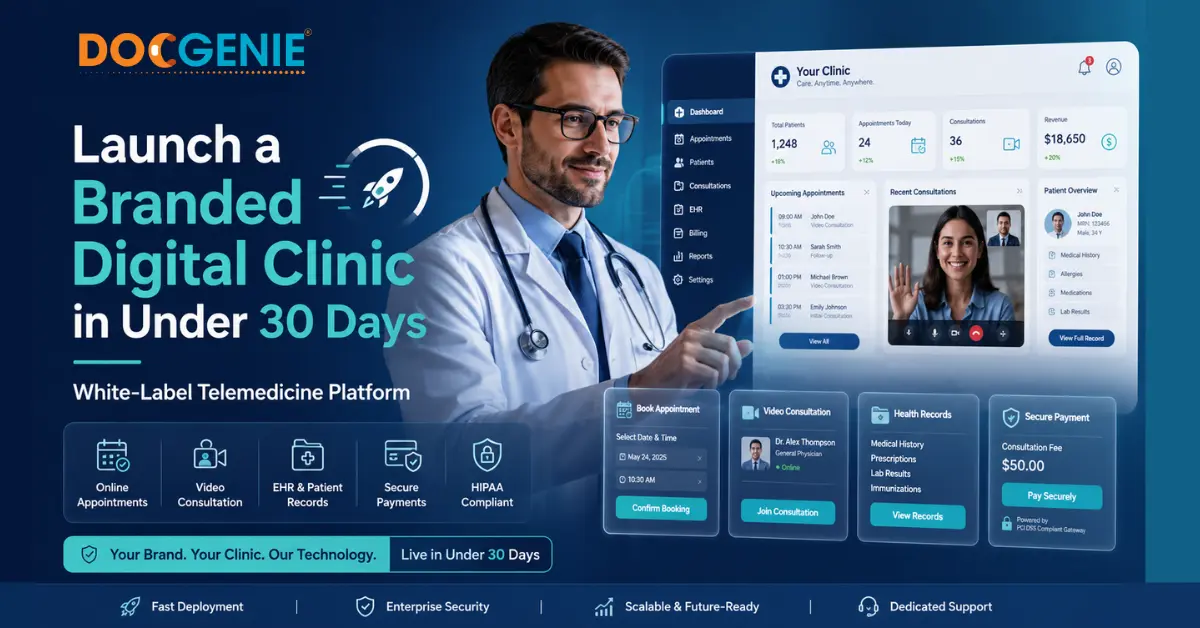
Launch a Branded Digital Clinic in 30 Days | DocGenie Global
Ready to enhance your telehealth services?
Discover how DocGenie Global can help you deliver superior virtual care experiences to your patients.